Meet the Models: Sabrina Baloun
Meet the Models: Sabrina’s Story – Lead with Empathy, Walk with Grace
Before her own diagnosis, Sabrina spent her career as a Physician Assistant in oncology. She diagnosed cancer, discussed treatment options, and supported patients through the hardest moments of their lives.
“I walked alongside people facing colon, rectal, ovarian, blood, and breast cancer. I knew their labs. I understood the science. I had seen the side effects. But I hadn’t lived it. Until I did.”
It began with a routine mammogram—then a callback, then another scan, then a lump. Sabrina saw the technician’s face change during the ultrasound and instantly recognized the look.
“I didn’t need the biopsy to tell me. I’d seen that face before. I already knew.”
She got the call on her way to the Cape, planning to celebrate her 50th birthday with friends. The voice on the line was gentle: “It’s not what we had hoped for.” Triple-negative breast cancer.
“Everything after that was a blur. I only had one question: Is this a death sentence? I knew the data. I knew what I was up against. I was terrified.”
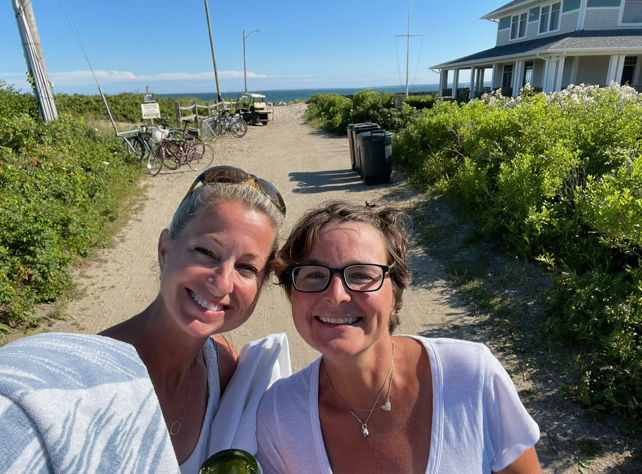
She went to the Cape anyway—but she cried for three days. Her friends held her as she unraveled, showing up with food, comfort, and quiet presence. It would become a theme.
Cancer in Isolation
Sabrina began treatment during the COVID-19 lockdown, which meant no visitors, no hand-holding, and no hugs in waiting rooms.
“I had to go to every chemo appointment alone. But by grace, a friend who’s a nurse practitioner at Dana-Farber happened to be working some of the days I was there. Just seeing her—knowing someone I loved was in the building—meant everything.”
A friend organized a meal train for her family, giving her sons nourishment during weeks when the smell of food was unbearable. Sabrina, who had always loved to cook, could no longer even enter the kitchen.
After treatment ended, the emotional fallout began.
“I didn’t fall apart during treatment—I was in survival mode. But after it ended, I finally did. I wish I’d had a therapist during treatment. It wasn’t until I joined a support group afterward that I started to really process what had happened.”
The isolation of cancer had been magnified by the pandemic. Therapy was on Zoom. Support groups were silent boxes on a screen. There was connection—but it wasn’t the same.
The Parts You Don’t See
Sabrina’s body changed. Her hair fell out. Her breast was removed. She adjusted, piece by piece—but the pain ran deeper than most realized.
“I’d prepared myself for hair loss, but when it happened, it was devastating. Seeing myself bald made it real. Made me feel sick. The comments from others—‘It’ll grow back!’—felt dismissive. I didn’t want reassurance. I wanted empathy.”
Even after reconstruction, she still struggled with what she saw in the mirror. The absence of nipples, the visible scars, the daily reminders.
“You don’t just go back to who you were. You grieve her. And then you slowly begin to discover who you are now.”
Empathy as a Lifeline
Through it all, what helped most were the people who showed up—imperfectly, consistently, and with love. One friend rode the Pan-Mass Challenge and wore Sabrina’s name on her shirt.
“When I saw her, I cried. That gesture told me: You matter. I’m with you. It wasn’t just about the fundraising. It was about being remembered, being seen, being loved.”
Sabrina now uses her voice to encourage others to lean in—especially when cancer makes people uncomfortable.
“Cancer makes people feel like a burden. But that’s when we need you most. Don’t wait for the perfect thing to say. Just check in. Say hi. Show up. And do it again tomorrow.”
Advice for the Newly Diagnosed
“Take it day by day—or second by second, if you need to. Don’t try to hold the whole journey all at once. Just focus on the next step. That’s where your strength lives.”
She also encourages patients to plan something joyful—even if it’s small, even if it needs to be rescheduled.
“Give yourself something to look forward to. Cancer shrinks your world down to appointments and side effects. A walk by the ocean, a trip, a night out—anything that reminds you that life still exists outside of this.”
At Runway for Recovery, we are honored to walk beside Sabrina. She reminds us that cancer is not just a medical diagnosis—it’s an emotional and spiritual transformation. It’s not always visible. It’s not always linear. But with empathy, with presence, and with connection, healing becomes possible—even in the darkest moments.