Laurie Turney’s Story
20th Anniversary Boston Model, Completed Treatment
How has breast cancer affected you?
“It’s been my life for 30 years,” Laurie says.
Laurie was first diagnosed at 34. Her second diagnosis came at 41. Looking back now, she can see how deeply those experiences shaped her, even though she never would have called cancer a gift at the time.
During her first support group, while she still had drains from surgery, another woman said cancer had been a gift.
Laurie remembers thinking the woman was out of her mind.
“I never went back to that support group,” she says.
Now, decades later, Laurie understands the sentiment differently.
It was not the cancer itself that was the gift. Cancer, she says, “sucks.” But what she learned by moving through it changed her.
“It’s kind of made me the person I am,” Laurie says.
What did breast cancer change for you?
Laurie and her husband had been married for just one year when she was first diagnosed.
They had planned to have children.
That changed.
“I never became a mother the way I wanted to,” Laurie says.
That loss still brings emotion, even all these years later. Breast cancer changed the future Laurie once imagined for herself and her family.
It also changed her body.
Laurie has had multiple breast surgeries, including reconstruction that used tissue from her abdomen. At 41, she had her ovaries removed and went into menopause immediately. She now keeps a close watch on her bone health because of the impact of both medication and early menopause.
Physically, she is not the same person.
But Laurie is strong.
She always has been.
And now, she knows that strength in a different way.
“I realize that I can do things when I think I can’t,” she says. “There’s a light at the end of this tunnel. I know because I’ve been there twice before.”
How were you first diagnosed?
Laurie’s first diagnosis began at a routine OB-GYN appointment.
Her doctor knew her family history. Laurie’s father had been diagnosed with breast cancer at 38 and died at 43.
During the appointment, her doctor asked if she was doing breast self-exams. Laurie said not really. She was not sure how to do them.
So he showed her.
As he was being thorough, he felt something. He had Laurie feel it too, though she could barely detect it herself.
Because she was young and had dense breasts, he told her it was probably nothing. He suggested she come back in a week for a mammogram.
At the time, Laurie was working as a nurse in radiology. Nervous about what the doctor had felt, she went to her friends in mammography and asked if they could help her learn what different lumps felt like.
A radiologist she knew offered to get her a mammogram.
The mammogram was negative.
But the lump was still palpable, so Laurie had a biopsy.
The next day, the results came back: cancer.
“I feel like, wow, that was a catch,” Laurie says.
Her cancer was stage II, with one lymph node involved. She had a lumpectomy, chemotherapy, and radiation.
Then she went nine years.
What happened with your second diagnosis?
After her first diagnosis, Laurie continued living her life.
She stayed active. She did sprint-distance triathlons. She rode her horse. Compared to what would come later, that first experience almost felt like a skipped beat.
At five years, Laurie was taken off tamoxifen, which was the standard practice at the time.
Around six or seven years out, her oncologist ordered a PET scan to check everything. Something small lit up in her neck, but it was too tiny to biopsy.
Doctors followed it with PET scans every three months. For about two years, it did not grow.
Eventually, they decided it was likely just a lymph node and extended the scan interval to a year.
By then, it had tripled in size.
Laurie was floored.
Doctors told her the cancer was stage IV, located above her clavicle between an artery and a vein. She was told that treatment would not change her mortality rate and that she could go on oral chemotherapy indefinitely.
But Laurie sought another opinion.
Her best friend, the director of breast cancer surgery at George Washington University, told her that was not acceptable and encouraged her to come for a second opinion.
There, Laurie met with an oncologist who told her something different.
“If you were my daughter, my wife, my sister, I would say go for a cure,” he told her.
So Laurie did everything.
Chemotherapy.
Radiation.
Double mastectomies.
Bilateral oophorectomy to remove her ovaries and reduce estrogen.
“I believe that’s what saved my life,” Laurie says. “I took away the fuel. I took away the breasts. I just did everything.”
She had just been married and was determined not to go through breast cancer a third time.
“I’m not doing this again,” she remembers thinking.
The treatment was brutal. Waking up in menopause was a shock to her body. She was tachycardic for weeks, her oxygen was low, and she needed supplemental oxygen.
But she got through it.
“Here I am,” Laurie says. “And glad to be here.”
What does 20 years cancer-free mean to you?
Laurie was once told she had three to five years.
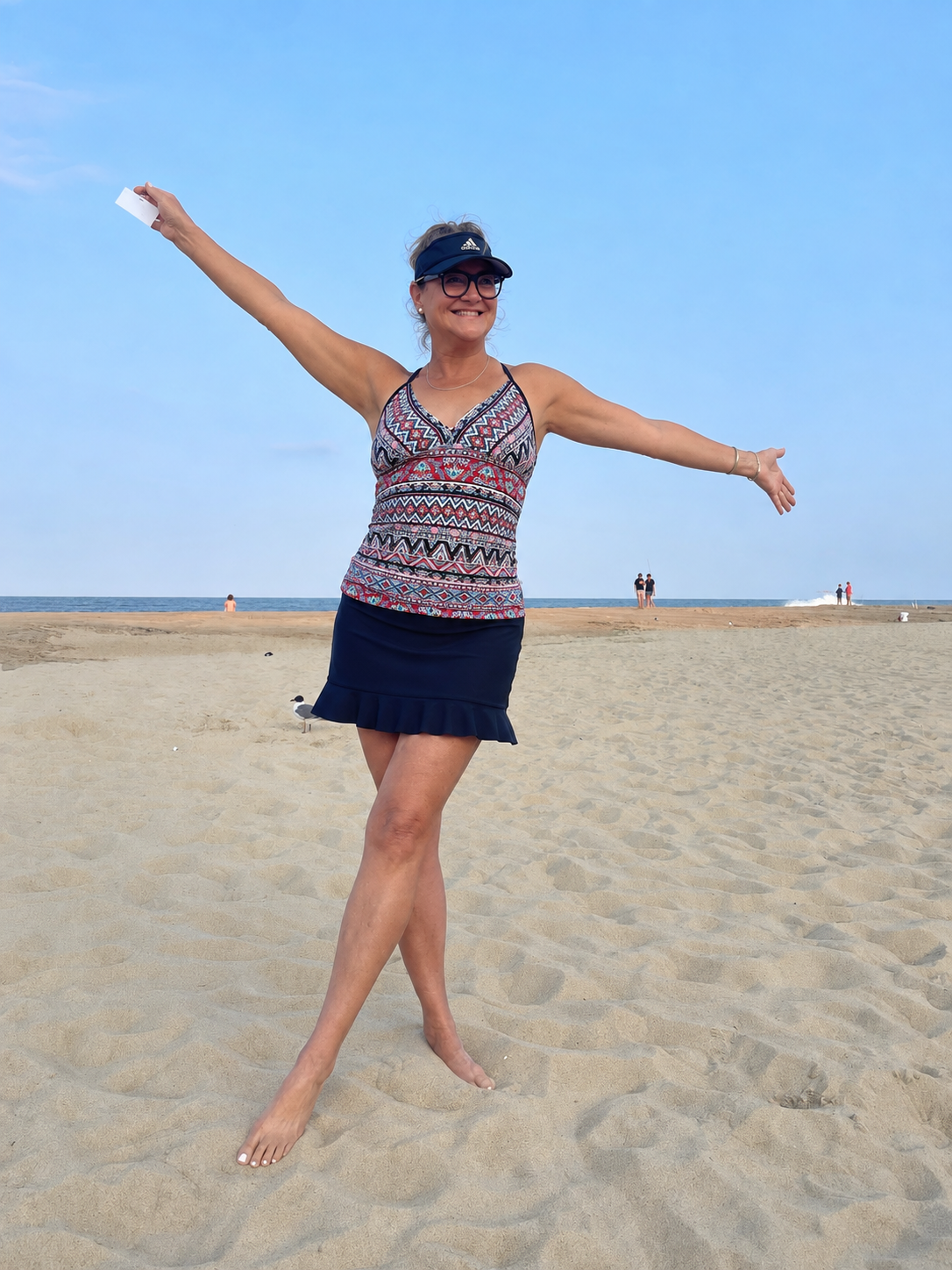
Today, she is 63 and a half. She feels great. And she has been cancer-free for 20 years.
“It’s my 20th anniversary too,” she says.
That milestone makes Laurie grateful for every single day.
She thinks often about how breast cancer shaped her 30s, 40s, and 50s. She wonders who she might have been or what her life might have looked like without it.
But she also knows the life she has now is wonderful.
And she does not take it for granted.
This October, Laurie and her husband are especially excited to be in Boston’s Seaport and celebrate Runway’s 20th Anniversary alongside Laurie’s own.
They are celebrating the last 20 years they did not know they would have.
“I think it’s really amazing,” Laurie says.
Why does your family history matter?
Laurie’s story carries an important reminder: breast cancer can come through the paternal side of the family too.
Her father was diagnosed with breast cancer at 38 and died at 43.
Laurie has been tested for every known gene, and so far, no identified mutation has explained her family history. She is involved in studies and trials, and researchers continue to test her blood as new mutations are identified.
Experts have told Laurie they believe there may be another hereditary mutation, something like a BRCA3 or BRCA4, that has not yet been identified.
“I think it’s got to be hereditary,” Laurie says.
Her story is a reminder that family history matters on both sides. Breast cancer does not only move through mothers, grandmothers, sisters, or aunts. Fathers matter too.
What are you most excited about with Runway?
Laurie found Runway for Recovery online, likely through Facebook.
As she prepares to walk, she is most excited to meet the other women, hear their stories, share her own, and be part of the community.
“Just meeting the other women, hearing their stories, sharing mine, being an inspiration,” Laurie says.
She has spent years helping others when she can. She has spoken at survivorship conferences, offered advice, and shared her story with women navigating breast cancer.
For Laurie, Runway feels like another way to do that.
She is looking forward to the camaraderie, the evening, and the chance to connect with people who understand.
We can’t wait for her to be a part of the 20th Anniversary show!