

Esther Kasin’s Story
20th Anniversary Boston Model, Currently in Treatment
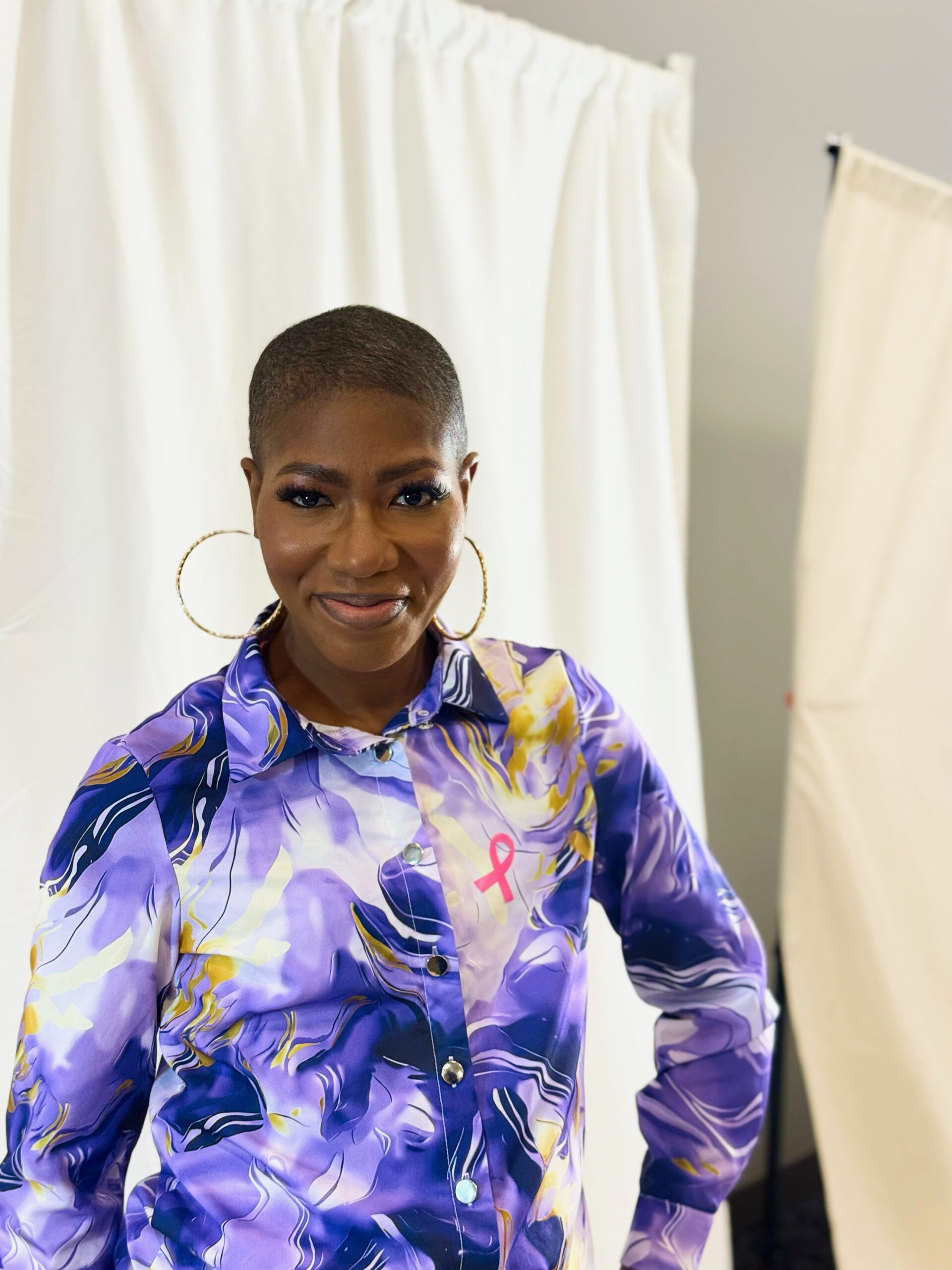
How has breast cancer affected your life?
Breast cancer has affected Esther Kasin’s life across generations.
Several women in her family had breast cancer, including two of her grandmother’s younger sisters. Esther remembers one aunt whose cancer had already spread by the time she learned about it, and another aunt who lived for a long time after her diagnosis.
One memory stayed with Esther deeply. When her aunt was in hospice, family members took turns sitting with her. So many people came to visit while she was still alive that her funeral felt like a celebration.
Esther remembers thinking that was how she would want it too.
“If anybody wants to come and see me while I’m still here,” she says, “then come.”
That experience shaped the way Esther thinks about life, illness, family, and celebration.
How did your own diagnosis begin?
Because of her family history, Esther began getting mammograms at 35.
For years, she had a lump that continued to test benign. No one recommended removing it. At times, it would shrink or go away, but it kept returning.
Then, when Esther was 43, she noticed the lump again while looking in the mirror.
This time, it was bigger than it had ever been.
At her wellness check, her primary care doctor scheduled her for a mammogram right away. Esther remembers that appointment as the longest mammogram she had ever had. She was told again that she had dense breast tissue, but she knew something was wrong.
“I knew then,” Esther says. “This is not good.”
After the mammogram, she cried in the car.
What was it like trying to get answers?
Esther’s path to diagnosis was long and painful.
After additional imaging, she was told she needed a stereotactic breast biopsy. But because of insurance issues, she was sent back and forth between offices for months. From May to October, she waited while the lump grew bigger and more painful. Pasted text
By November, Esther’s breast was bleeding. She used nursing pads, then cut-up maxi pads, just to absorb the blood while she waited for her biopsy.
When the biopsy finally happened, it was painful and emotional.
“I was crying for my mom,” Esther says.
On November 29, 2023, her youngest son’s fifth birthday, Esther was diagnosed with stage one triple negative breast cancer and DCIS.
What did treatment look like?
Esther’s treatment did not go the way she expected.
At first, the plan was surgery, radiation, and reconstruction. She hoped to avoid chemotherapy if surgery could remove everything.
Her first surgery was on January 11, 2024. Within weeks, she was back in surgery because the disease had spread and more tissue needed to be removed.
Later, Esther learned that the surgery had been incomplete. A second-opinion surgeon in Baltimore showed her the scans and explained that cancer had been left behind. Esther had to start over with a new team, including a new breast surgeon, plastic surgeon, radiation oncologist, and medical oncologist.
“It was still there,” Esther says.
In September 2024, her new team removed the remaining cancer. Then, in early 2025, Esther had another surgery after cancer was found in her lymph nodes. Her surgeon also completed the bilateral mastectomy Esther had wanted from the beginning.
How did you keep advocating for yourself?
Again and again, Esther had to push for the care she needed.
She had to ask questions. She had to request resources. She had to advocate to stay overnight after surgery and to have a home health nurse. Her mother, a colorectal cancer survivor, helped her understand what questions to ask and what support she should have been offered.
After moving back to Ohio to be closer to family, Esther began care at Ohio State, where she finally felt well supported.
Her new team moved quickly when something felt wrong. When Esther noticed another lump under her armpit and sent a photo through MyChart, her doctor called right away and brought her in that same day.
Esther appreciated that honesty.
“I like that she was blunt and honest with me,” Esther says. “Just keep it real with me, and I’m gonna be okay.”
Where are you today?
In June 2025, Esther learned the cancer had recurred again in her lymph nodes. It was still local, not metastatic, but it had spread further in the left side.
Her treatment plan included chemotherapy with carbo, Taxol, Pembro, and then the “red devil.”
But Esther gave that last one her own name.
Because it was Christmastime, she decided to call it the “Red Truffle.”
“I gotta make it Christmasy,” Esther says.
That humor became part of how she moved through treatment. She had her care team laughing each time she asked, “Where’s my Red Truffle?”
Even in the hardest moments, Esther finds a way to bring humor and light into the room.
What does Runway mean to you?
When Esther learned she would be part of Runway, she became emotional.
To her, being celebrated this way felt deeply honorable.
“This is how you should treat cancer people,” Esther says. “We need to be celebrating because we go through so, so much.”
For Esther, cancer is not one hard day. It is something that affects every day.
“It’s not just one day,” she says. “It’s every day.”
Runway offers Esther something different from the pain, confusion, and delays she has had to endure. It offers celebration.
We can’t wait to celebrate with her.