Debbie First’s Story
20th Anniversary Boston Model, Completed Treatment
What does it mean to you to return for Runway for Recovery’s 20th anniversary?
For Debbie First, returning to the Runway stage means looking back at just how much can change in 20 years—and, in her case, nearly 50.
Debbie has been connected to Runway from the very beginning. She knew Olivia’s mother, Cande, through their involvement with the Handel and Haydn Society. Years later, Debbie reconnected with Olivia at a wedding, where Olivia told her about the organization she was beginning and asked Debbie if she would walk.
Debbie said yes.
She remembers those early Runway days as joyful, intimate, and full of energy.
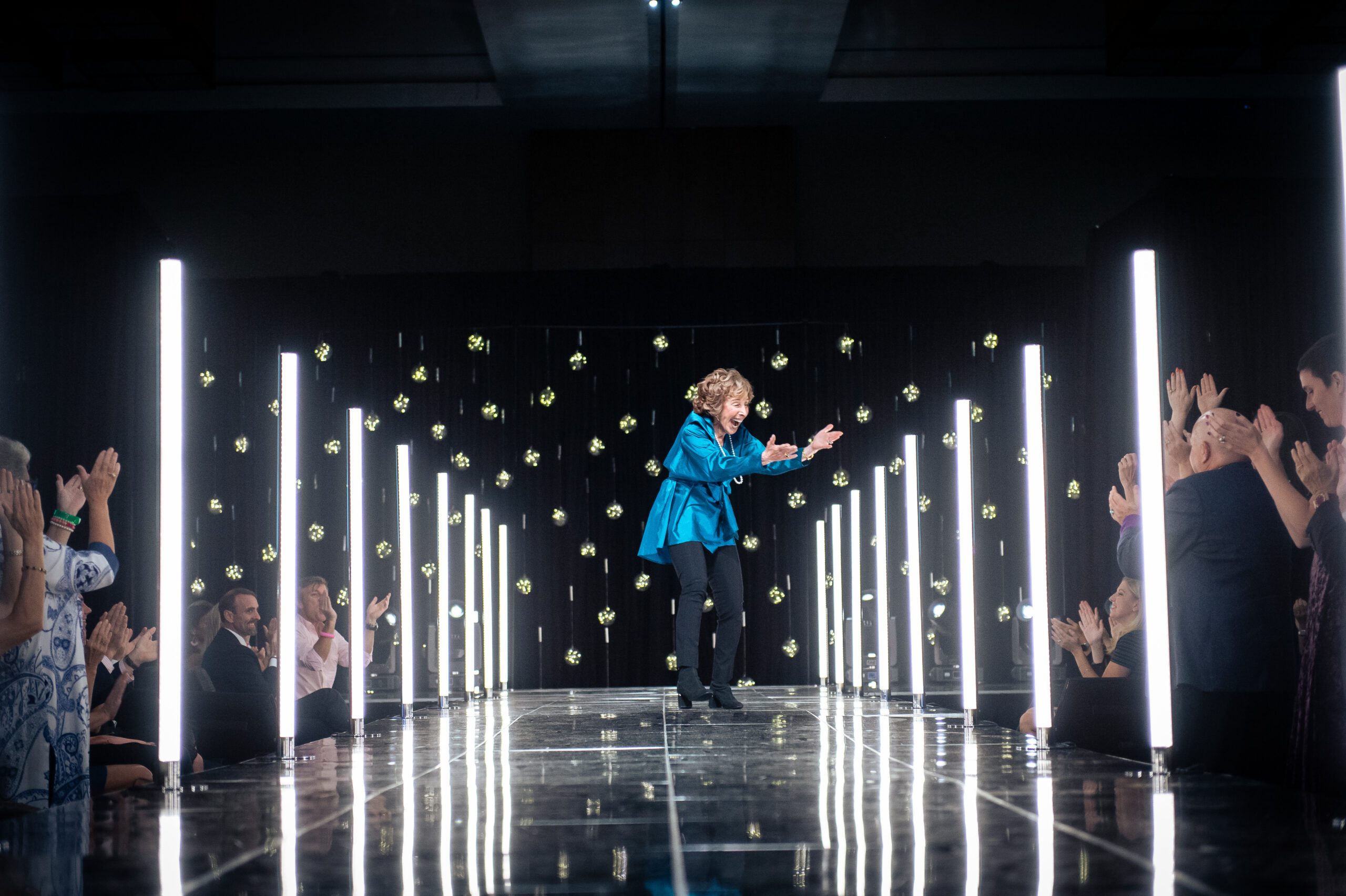
“The music inspires because I am very much that kind of person. I dance down the aisle.”
Debbie also used her longtime connection to Dana-Farber to help introduce Olivia to the organization during Runway’s early years. Now, after watching Runway grow for two decades, Debbie is returning to celebrate what it has become.
“What it means to me is a chance to celebrate the success of Runway for Recovery,” Debbie says. She has watched the organization grow into something that recognizes not only the person facing cancer, but the entire family surrounding them.
“It shines a light not just on the patient but on whomever she invites to walk with her. And that’s just beautiful. It’s joyful. It’s upbeat.”
For Debbie, that joy matters. Cancer asks so much of a person and their family. Runway creates a space where, even in the midst of everything else, people can simply celebrate one another.
Tell us about your own cancer journey.
Debbie was diagnosed with ovarian cancer in 1977, when she had three young children.
At the time, ovarian cancer was something Debbie felt she could not even tell people she had.
“I didn’t ever think I wasn’t going to survive it, but so many around me did.”
Her priority was keeping life as normal as possible for her children. She worried that if people knew her diagnosis, they would immediately assume the worst.
“I had three children to make life normal for.”
Debbie underwent 13 months of difficult treatment at Dana-Farber. Her oncologist, Dr. David Livingston, adapted a treatment being used for another cancer to treat her particular ovarian cancer. At the time, Debbie says, the treatment was experimental.
Years later, she learned that the same treatment has become a standard of care for her type of ovarian cancer.
That experience became the beginning of a lifelong relationship with Dana-Farber. Debbie has served on the Dana-Farber board and led its Women’s Cancer Executive Council. Her family’s connection to Dana-Farber now spans generations, including 32 years biking in the Pan-Mass Challenge.
Her life outside of cancer has been equally full. After completing treatment, Debbie went on to serve as head of Massachusetts Tourism under Governor Michael Dukakis, build a career in public relations, raise her family, join several non-profit boards and become a grandmother of seven.
What has changed since your diagnosis in 1977?
Almost everything.
Debbie remembers a time when women’s cancers were discussed and treated very differently. Today, advances such as genetic testing can help families understand their risks and take action before a diagnosis ever comes.
For Debbie, that progress is enormously meaningful.
Her own children have undergone genetic testing. One has no identified genetic risk, while another is being monitored.
“The thing is being watched versus being treated.”
That difference represents decades of medical progress.
Debbie hopes her story reminds others of the importance of education, awareness, and understanding what resources are available to them.
“There’s not one answer. It’s really being open to what is out there and, how do I access it?”
Looking back, Debbie knows just how different her experience might have been if she had the information and resources available today.
What will you be celebrating when you step onto the Runway stage?
Debbie will be celebrating survival, family, progress, and possibility.
When she was diagnosed in 1977, she was a mother of three young children trying desperately to keep their world normal.
Today, those children are grown. Debbie is a grandmother. Her family now spans generations, and nearly five decades have passed since the diagnosis that once made everyone around her fear for her future.
That gives Debbie a perspective few people can bring to the Runway stage.
She has watched treatments evolve. She has watched conversations around women’s cancers change. She has watched Dana-Farber grow. And she has watched Runway for Recovery transform from a small gathering into a community supporting families far beyond the runway itself.
“I look at it through an historic lens.”
And when Debbie looks through that lens, what she sees most clearly is hope.
“I dance down the Runway with appreciation for the philanthropic support for families with cancer, but also with hope for a time when cancer is defeated and the Runway is just a fashion statement."