
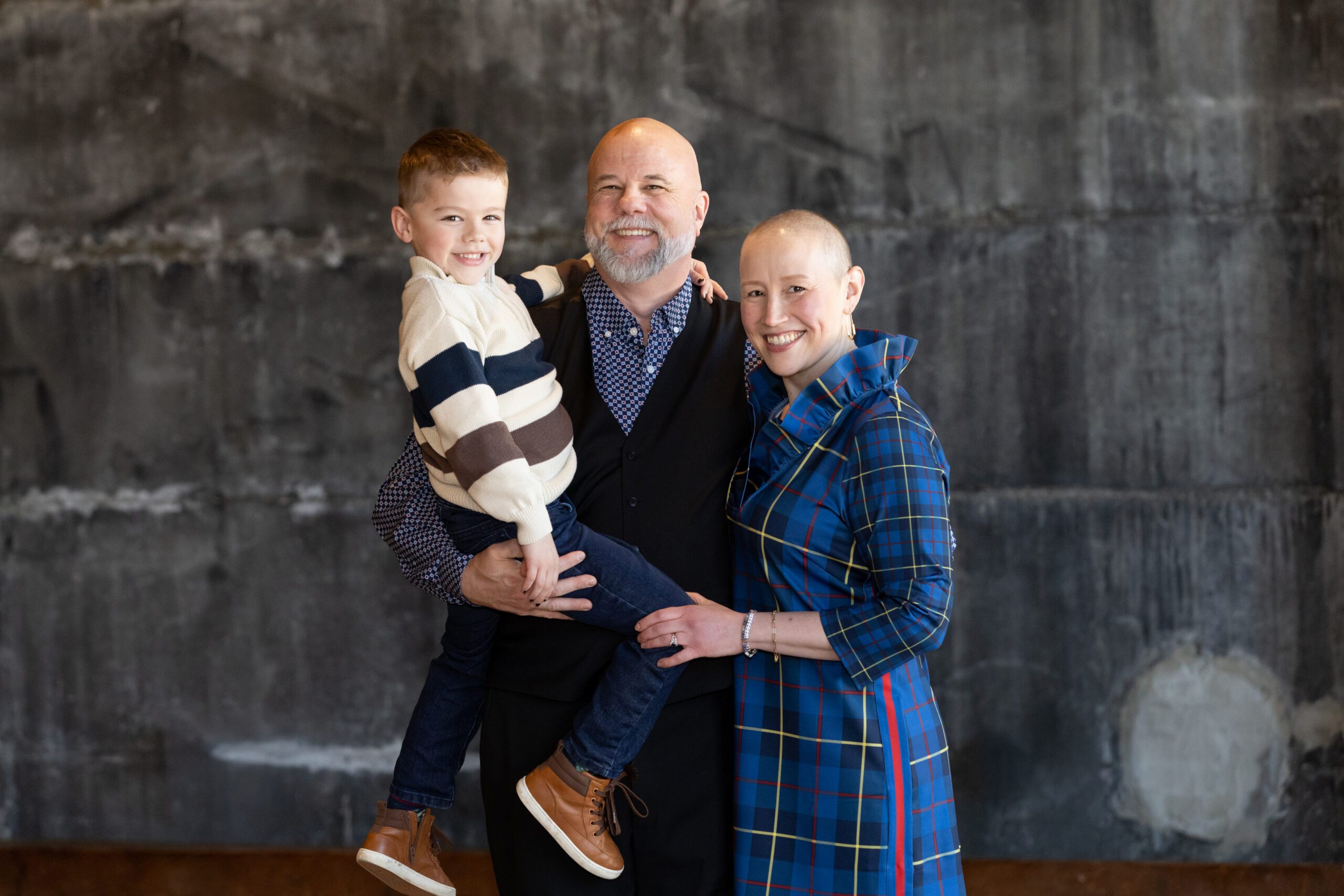
Emily Knight’s Story
20th Anniversary Boston Model, Living with Metastatic Breast Cancer
When were you first diagnosed?
Emily Knight was diagnosed with breast cancer in March 2022, just before her 40th birthday.
“I felt and saw something which sparked the mammogram,” Emily says.
She was diagnosed with invasive ductal carcinoma in her left breast. There was no known family history of breast cancer, and the diagnosis came as a complete shock.
“Total shock out of left field,” Emily says.
Her cancer was triple positive and fast growing. Because doctors had imaging from a previous mammogram a few years earlier, they could see how quickly it had appeared. Treatment moved fast.
Emily began chemotherapy within weeks of diagnosis.
“It was a summer of TCHP,” she says. “Pretty intense chemotherapy.”
After chemo, Emily had a bilateral mastectomy. At that point, there was no evidence that the cancer had spread to her lymph nodes, and she had a full pathological response to treatment. Her outlook was positive.
What happened after treatment?
After her mastectomy, Emily chose natural reconstruction through a DIEP flap procedure.
The recovery was extremely difficult, and she has continued to face complications from that surgery. Her body rejected sutures and mesh, and she has undergone multiple surgeries as a result.
“I’m still struggling with issues from that surgery,” Emily says.
In January 2027, Emily is scheduled for another surgery related to those complications.
The experience has been physically and emotionally exhausting. But, in a strange and unexpected way, one of those complications helped reveal something important.
Pain from a seroma in her abdomen became unbearable, and Emily went to her primary care doctor thinking she might have a hernia. Imaging showed the seroma — and also revealed that her cancer had metastasized to her bones.
“That kind of saved my life in a way,” Emily says.
How did you learn the cancer had metastasized?
Before that imaging, Emily had been experiencing pain in her hamstring for months.
She thought she had pulled it. She is active, and it was winter. She had been sledding with her son, going up and down hills, and assumed she had hurt herself.
“I just thought, okay, I’m in my 40s. I did something stupid,” Emily says.
But the pain was not a pulled hamstring.
The cancer had metastasized to her left ischium, the bone where the hamstring tendon attaches. The cancer was eating away at that bone and loosening the attachment, which explained the pain she had been feeling.
“Thankfully, that was identified due to the imaging from the abdomen issue,” Emily says.
Emily went through chemotherapy again, had the cancer removed from that bone, and received radiation to the area. Since then, her scans have been clear.
“I’m on three different treatments indefinitely,” she says. “And I’m doing quite well on all of them.”
What has living with metastatic breast cancer looked like for you?
Emily is living with metastatic breast cancer, but she is also living her life.
Her current treatments are manageable, and while medically induced menopause has brought hot flashes, joint pain, and other side effects, Emily says much of it feels livable.
“It’s livable for sure,” she says.
Emily finds hope in the women she has met who are living with metastatic disease, including those who have been living with the disease for years.
“It gives me so much hope,” she says.
In her metastatic support group, Emily has lost people, which is deeply hard. But she has also met women who continue to live fully, whether they have no evidence of disease or have experienced recurrences along the way.
“They are living life,” Emily says.
What would you tell someone newly diagnosed?
For Emily, the answer is clear: find community.
“I would say the community is the most important thing,” she says.
She encourages people to seek out reputable sources of support, whether through hospitals, foundations, organizations, or groups connected to their care teams. For Emily, support groups through MGH have been especially meaningful, and she also speaks highly of organizations like the Ellie Fund.
“There’s so much noise on social media,” she says. “There are so many resources and misinformation.”
That is why, for Emily, finding grounded, trustworthy support matters so much. And community is at the root of this.
How can people best support someone going through treatment?
Emily has thoughtful advice for friends and family members who want to help.
First, be careful with unsolicited advice.
People often share stories or suggestions because they want to connect, but Emily encourages people to ask before offering advice, especially if it involves another person’s difficult or negative experience.
She also remembers the practical support that helped most.
Gift cards for food delivery were incredibly useful because treatment makes even the thought of feeding yourself or your family feel overwhelming. Grocery gift cards can be wonderful, but Emily points out that they still require planning, shopping, and cooking. A meal that can simply arrive at the door can be a gift.
Another gift she will never forget came after reconstruction: a gift certificate to a bra boutique.
“That was so, so sweet,” Emily says.
A thoughtful gift that acknowledges those changes with care and dignity can mean so much.
“You’re holding on to some type of normalcy of yourself,” she says.
What has cancer changed about how you see your body?
Emily has spent years trying to feel like herself again.
“The amount of changes your body goes through, I can’t,” Emily says.
She has spent time, energy, and money trying to reclaim pieces of how she used to look and feel, from clothes to eyelashes to eyebrows.
“You look in the mirror and you’re like, that’s not me,” she says.
That is part of why Runway matters.
It is a night where models can feel celebrated in bodies that have been changed, challenged, and carried through so much.
What are you looking forward to about Runway?
This will be Emily’s first time walking with Runway for Recovery.
It is a place where she can stand alongside other women living with metastatic breast cancer and see that they are still here, still living, still fierce, and still full of hope.
We can’t wait to offer Emily another kind of community.