Lauren Bonato’s Story
20th Anniversary Boston Model, Currently in Treatment
When you think about your breast cancer story, where does it begin?
For Lauren Bonato, the beginning of her breast cancer story still feels almost impossible to believe.
“This time last year, we had no idea what was in store for us,” she says.
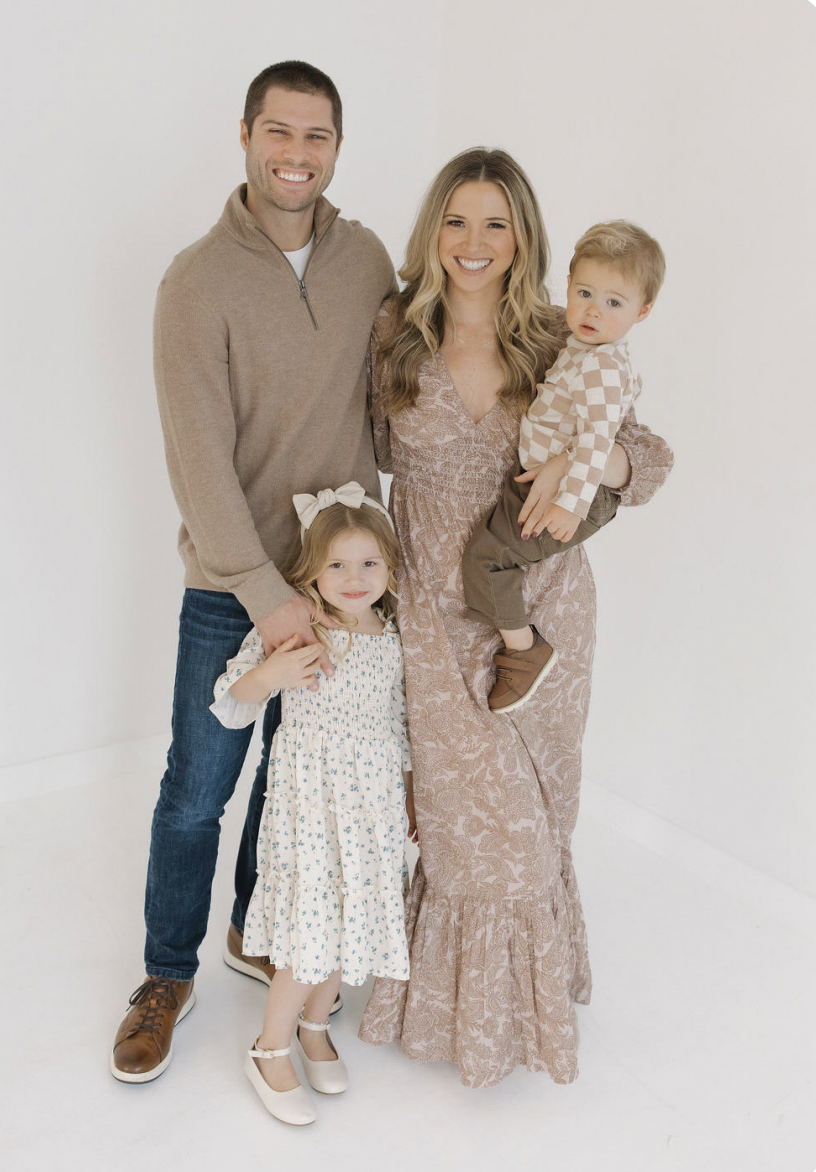
Lauren is 36 years old and the mother of two young children: a daughter who is now four and a half and a son who just turned two. Last year, she had recently stopped breastfeeding her son and was used to the changes that can happen in the body during and after that season of life.
Then, one night in October, she felt something small.
“I was sitting down watching TV one night, and I must have brushed up against myself,” she remembers. “I thought I felt a little something.”
A few days later, she felt it again in the shower. It was small, movable, and easy to explain away. Her period was coming. She had recently weaned. She was young and healthy.
But Lauren’s mother had been diagnosed with stage zero DCIS in 2019, and that family history made her pay attention.
“Just because of that, I was a little bit more aware of what was going on,” she says.
Lauren reached out to her OB-GYN, who told her to come in. Her doctor felt the lump and agreed she should have a mammogram.
“To this day, I feel like if I didn’t have the history of my mom having stage zero, I don’t know if they ever would have sent me,” Lauren says.
What happened after your mammogram?
Lauren went into the appointment expecting it to be nothing.
“I was completely confident,” she says. “I’m young, I’m super healthy, I do all the right things.”
She had coached her daughter’s soccer game the day before and planned to go to the mammogram and ultrasound before work, check the box, and move on.
But during the ultrasound, the room changed.
“She was talking to me, we were having fun, and then she got really quiet,” Lauren remembers. “I knew something wasn’t right.”
The radiologist came in. Lauren asked whether it could be a fibroadenoma or a cyst.
“She told me no,” Lauren says. “From the get-go, she was like, ‘No, that’s not what we’re looking at here.’”
Lauren had gone alone because she never expected bad news. A biopsy was scheduled two days later. By then, she had been told there was a 95 percent chance it was breast cancer.
She received the official diagnosis on November 3, the day before her daughter’s fourth birthday.
“It was the most unbelievable moment,” Lauren says.
Her cancer was hormone-positive and HER2-positive. It was also found in one lymph node, which meant she needed additional scans: a bone scan, CT scan, and MRI.
“That was the worst time of my entire life,” she says. “I’ve never felt anxiety like that. I’ve never felt fear like that.”
How did you talk to your children about what was happening
Lauren’s children were her first thought.
Her daughter was about to turn four. Her son was still so little. Lauren decided early on that she wanted to protect them from fear as much as she could.
“To this day, my kids have no idea that anything’s even gone on,” she says. “They know I had a surgery, but they have no idea why.”
She did not want to cause them stress or anxiety unless she had to. So she moved through treatment while keeping their lives as steady as possible.
If she felt run down, they stayed in and watched a movie. But Lauren made it to the things that mattered: Christmas, school events, recitals, birthdays, and everyday moments.
“I didn’t miss anything,” she says.
What shifted for you before treatment began?
Lauren was supposed to start chemotherapy the first week of December, but she was not ready.
“I was so nervous and so anxious I couldn’t even say the word chemo,” she says.
She pushed it off. She ignored calls. She was not mentally in a place where she could walk through the door.
Then something changed.
The night before her first chemo, Lauren shared her diagnosis online.
“I was carrying this heavy weight of this secret,” she says.
Her family and closest friends knew, but she had not told others. Part of her felt ashamed, confused, and unable to understand how this could be happening when she was so young and healthy.
“How could this be happening to me?” she remembers thinking.
The moment she shared it, the weight lifted.
“The amount of people that reached out — girls my age, even younger, who were either going through it, whose sister had gone through it, or who were going through it privately — it’s just been unbelievable.”
From that point on, Lauren felt a switch flip.
“I have been given this, and it sucks, it’s terrible, but I have to make something positive out of this,” she says. “There was no way I was going to go through this and not turn it into something good.”
How did you get through chemotherapy?
Lauren began chemotherapy on December 10.
At first, she feared chemo would hurt her, keep her in bed, and make her miss out on her children’s lives. But before her first treatment, she decided to change the way she thought about it.
“I went from thinking, this is going to hurt me, to being like, no, this is going to help me,” she says.
That mindset carried her.
Lauren does not minimize how hard treatment was. But her body tolerated chemotherapy in ways she never expected, and she found herself looking for small wins.
“If I think it’s going to hurt me, it probably will,” she says. “But I have to go in there knowing that this is going to help me.”
Her support system made all the difference. Her friend Abby came to every chemo with her. Her parents cold capped her through every treatment, changing the cap every 25 minutes for nine hours a day.
“My parents doing that was just everything,” Lauren says. “It was such a teamwork effort.”
Cold capping helped Lauren keep her hair, something that mattered deeply to her during a time when so much felt out of her control.
“It seems so vain,” she says. “But when you’re 36 years old and you have two young kids, I need to live my life. I want to feel like myself.”
She had a plan if it did not work. But it did. And keeping that part of herself helped.
“I felt like I was losing so much of myself,” she says. “If I could try to keep part of me that made me feel like me, that was huge.”
What did surgery look like?
Lauren’s last chemo was April 1. Her surgery was May 7.
She had never had surgery before, and suddenly she was facing a major one. But as she looked at surgery dates, one thing mattered most: her daughter’s recital was the following week.
“I know this sounds silly,” Lauren says. “I have her recital, and I need to be there.”
Her team told her she could be there. She might not be comfortable, but she could go.
And she did.
Her daughter knew Lauren had surgery, but not why.
“I told her I had a silly little boo-boo,” Lauren says.
Her daughter thought the location was funny and became Lauren’s biggest helper, especially with her younger brother.
Lauren’s pathology brought more small wins. Halfway through chemo, she could feel the tumor shrinking. After surgery, her results showed a near-complete response, which is not common with her subtype. Her lymph node was clear.
“All of these things, I’m just so grateful for,” she says.
She wants someone newly diagnosed to see that treatment does not always look like the worst-case scenario they may be imagining. She wants them to know there can still be beauty, support, joy, school plays, recitals, birthdays, and ordinary moments woven through the hardest days.
Where are you in treatment now?
Lauren is still in treatment.
The day of her interview with Runway was her first day of radiation. Next will come Lupron and hormone therapy, which will put her into menopause and continue for years.
But Lauren is trying to keep the same mindset that helped her through chemo and surgery.
“I’m already in it, so let’s just do it,” she says.
Her question has become a kind of guide.
“What’s the best that could happen?” Lauren says. “What is the best possible outcome here?”
She knows there are many things that could go wrong. But she also wants to leave room for what could go right.
What has this experience taught you?
Breast cancer has taught Lauren that you never really know what someone else is carrying.
Because she cold capped and kept her hair, people often could not tell she was going through treatment. She looked healthy, even while moving through chemotherapy, scans, surgery, and fear.
“It really opened my eyes to the fact that you have no idea what someone’s going through,” she says.
People sometimes told her she did not look sick. And while Lauren knows she is lucky in many ways, she also knows that invisible struggles are still real.
“You really don’t know what anybody else is going through,” she says. “And what their path looks like that they’re walking.”
It also taught her that cancer does not only happen to people who are older or unhealthy.
“You’re not too young. You’re not too healthy,” she says. “It doesn’t pick.”
How are you feeling about stepping onto the Runway stage?
Runway feels aligned with what Lauren has been trying to hold onto all along: joy, hope, visibility, and community.
She is still in treatment, but she is also still living. Still mothering. Still showing up. Still looking for the good.
On the Runway stage, Lauren will walk as a young mother, a woman in treatment, and someone determined to turn fear into purpose.
She is walking for her children, for the women who reached out after she shared her diagnosis, and for anyone who needs to see that even in the middle of treatment, there can still be beauty, support, joy, and hope.
Instead of focusing only on everything that could go wrong, Lauren has tried to hold onto another question: what if things go right?
“What’s the best that could happen?” she says.