Lori Coleman’s Story
20th Anniversary Boston Model, Completed Treatment
When you think about your breast cancer story, where does it begin?
Back in 2017, Lori was on a high-risk monitoring plan, alternating mammograms and MRIs every six months.
Eventually, her care team referred her to oncology, even though it was not cancer at the time. They recommended Tamoxifen, and Lori stayed on it for four years.
In August of 2023, after years of everything remaining stable, Lori and her oncologist decided she could stop taking it.
“Everything’s been status quo for four years,” she remembers thinking. “Let’s stop the Tamoxifen.”
Two weeks later, she had a mammogram. A week after that, she was diagnosed with breast cancer.
“I know in my head I did not get it in those two weeks,” she says. “I was one of those lucky people that got breast cancer while taking Tamoxifen.”
What do you remember about the day of your mammogram?
Lori remembers being her usual self in the waiting room—using humor to calm everyone else down.
“I was being the jokester,” she says. “Putting everybody else at ease.”
She talked with the other women about MRIs and what it is like to get on the table for breast imaging. One by one, the other patients got to leave.
Lori had to stay.
When she received the call with results, she expected to hear that it was atypia again.
“I totally anticipated, ‘Hey Lori, it’s atypia. No worries,’” she says.
Instead, she was told they were pretty sure it was cancer.
“They caught it super, super, super early,” she says.
What was your treatment plan?
Lori was diagnosed on October 11, 2023, and had a lumpectomy just over a week later. During surgery, doctors also removed lymph nodes. One came back positive for cancer.
At first, Lori was told her cancer was small and early, and she might not need chemotherapy. But then came the wait for her Oncotype score.
That wait stretched on for nearly a month.
“I kept calling,” she says. “I had to cancel oncology twice because there was nothing—no news to tell me.”
Eventually, Lori learned that the delay was because insurance had denied the test, but no one had told her.
“It was crickets,” she says. “So you can imagine a month of spinning my wheels, doing nothing, knowing that I could still have cancer in my body. I was a wreck.”
When the score finally came back, it was a 35, which changed the plan. Chemotherapy and six weeks of radiation were recommended.
“I promised my kids I would do anything I needed to do to be here for them,” Lori says. “So let’s do the chemo.”
She completed four rounds of chemotherapy, once every three weeks, followed by six weeks of radiation.
What happened after chemo and radiation?
After radiation, Lori tried an additional medication her team hoped she could take for two years. But the side effects were immediate and severe.
“Within an hour of taking the first dose, I was throwing up in the trash barrel,” she says.
Even after lowering the dose, the side effects continued. Eventually, her oncologist told her they had given it an honest try and felt comfortable stopping it as long as Lori continued taking Anastrozole.
By April 2024, Lori had completed active treatment and moved into monitoring.
“I had my MRI last week, and all clear again,” she says.
Was breast cancer your only diagnosis during that time?
No. In February 2024, while still navigating breast cancer treatment, Lori went for her annual skin check and was diagnosed with malignant melanoma.
“So I said to my husband, we really need to go to Foxwoods Casino,” she jokes. “Because if I have this kind of crappy luck, maybe I can pull out some good luck.”
Fortunately, the melanoma was found very early and was treated surgically without radiation.
How did breast cancer impact your family life?
When Lori was diagnosed, her family was also caring for Scarlett, a foster child they had welcomed at 10 and a half months old. Scarlett was substance-exposed and has cerebral palsy, along with developmental challenges. Lori was terrified that if the Department of Children and Families knew about her diagnosis, Scarlett might be taken away.
A friend who works for DCF helped reassure her.
“She said, ‘First of all, how are you? Let’s talk about that,’” Lori remembers. “And then she said, ‘You don’t know what’s going to happen yet.’”
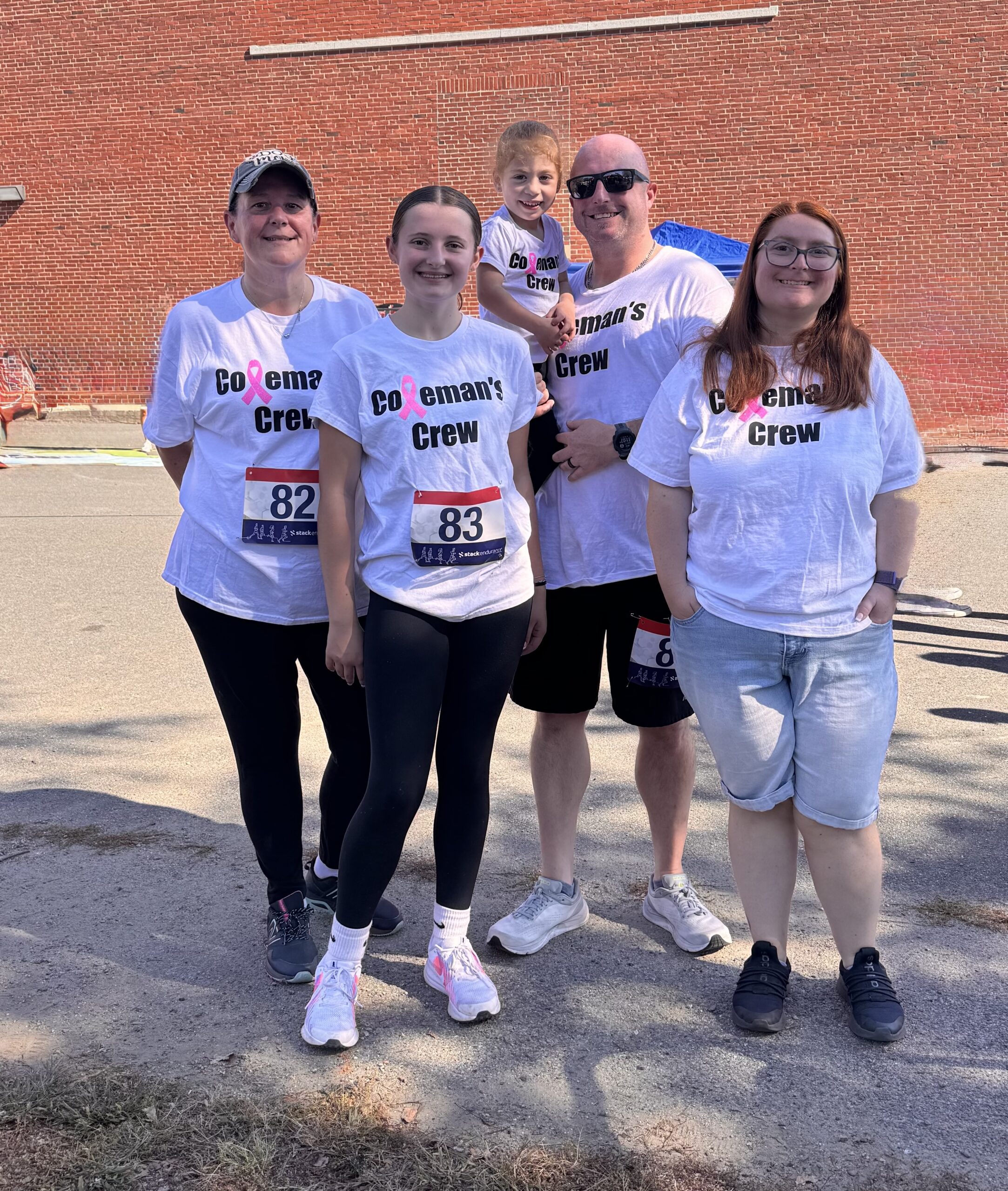
Lori and her husband went on to adopt Scarlett. Today, Lori has three daughters: a 29-year-old on the autism spectrum, a 14-year-old, and five-year-old Scarlett.
“I have every age and stage in my house,” she says.
For Lori, motherhood has always been connected to legacy.
“I just want to raise good humans,” she says. “That has always been my goal—to leave this earth better than I found it. And my children will be my legacy to do that.”
How did your children respond to your diagnosis?
Lori’s 14-year-old daughter struggled at first.
“She did not do well,” Lori says. “She buried her head, wouldn’t talk about it. She was just a very angry little girl.”
So Lori took her to a rage room—a place where people can safely smash things.
“I let her smash everything,” Lori says. “And she came out a totally different child.”
That experience helped her daughter process some of the fear and anger that came with watching her mother go through cancer.
How did you handle losing your hair?
Lori tried cold capping during chemotherapy, but even though she did not lose all of her hair at once, the shedding became emotionally overwhelming.
“As it came out, it looked worse in my hands than it did in my hair,” she says.
Her children would find hair and try to hide it from her so she would not see.
Eventually, Lori’s best friend—who has been her hairdresser since they were 14—helped her make the decision to buzz it.
“She said, ‘You know what? I think it would just relieve the stress if we buzz it,’” Lori remembers.
They did not shave it completely; they buzzed it very short. Lori remembers that although she was not happy to lose her long hair, the relief was immediate.
“If you look at the photos from when I first walked into the salon to when I was leaving, the weight that lifted off of me—the change in my face,” she says. “It was just the relief that I didn’t have to worry about it anymore.”
How do humor and helping others show up in your story?
Humor has been one of Lori’s ways of getting through the hardest moments.
Even when she talks about cancer, she finds a way to bring light into the room. When preparing to support a 13-year-old family friend with aggressive Non-Hodgkin’s lymphoma as she shaved her head, Lori considered bringing a cake that said, “Buzz off cancer.”
“Why can’t it be a party?” she says.
That same night, Lori planned to pass along a bracelet she had worn throughout her own diagnosis and treatment—one that, in Morse code, says “F cancer.”
“I haven’t taken it off since I was diagnosed,” she says. “I’m going to hand it off to her and tell her she needs to keep it on until she needs to pass it on to someone else that needs it.”
For Lori, showing up for others is part of what it means to keep going.
How are you feeling about modeling in Boston?
For Lori, modeling is another chance to be part of a community built on connection, courage, and celebration.
She is coming to the stage after treatment, after adoption, after fear, after uncertainty—and with the same humor and heart that carried her through it all.
Lori’s story is one of early detection, persistence, motherhood, and choosing to keep showing up for the people around her. She is a survivor, a mom, an adoptive mom, a friend, and someone who wants the next person facing cancer to feel less alone.