Ashley Edge’s Story
20th Anniversary Boston Model, Completed Treatment
When you think about your breast cancer story, where does it begin?
Ashley was diagnosed with breast cancer in September of 2023.
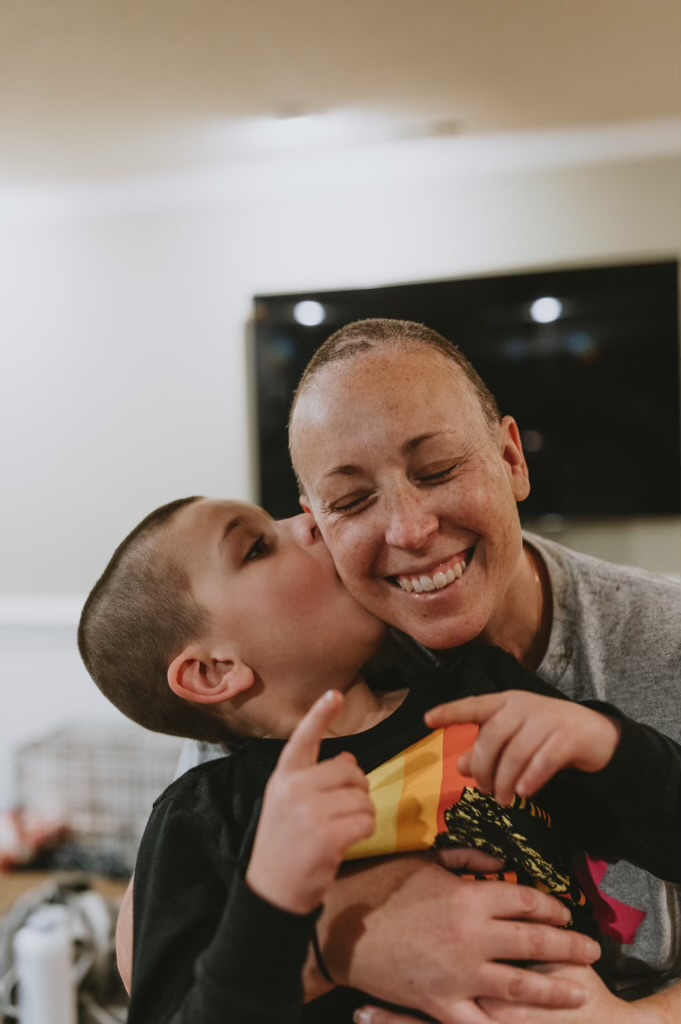
At the time, her son, Carter, was six years old, almost seven. Ashley had always been the primary parent: working full time, managing school pickups, transportation, sports, and the daily rhythms of their life.
“I had always been the primary parent that just did it all,” she says.
At first, Ashley’s treatment plan seemed straightforward. She was not expected to need chemotherapy or radiation. She opted for a double mastectomy, and because doctors did not believe the cancer had spread to her lymph nodes, she was able to have reconstruction at the same time.
Because Carter was so young, Ashley did not want him to know she had cancer.
“It was Mommy’s having surgery to fix a boo-boo in her chest,” she says.
When did your treatment plan change?
A week after surgery, Ashley got the call that the cancer had spread to one of her lymph nodes.
Everything shifted.
“What was only going to be like a two-month thing went into seven months,” she says.
Her diagnosis was classified as stage 2A, estrogen and progesterone positive breast cancer. The new plan included chemotherapy, hair loss, and radiation.
At the same time, Ashley had signed up to coach Carter’s basketball team. The season was set to begin the same week she started chemotherapy.
“I had to back out of that,” she says.
That was when Ashley knew she needed to tell Carter more.
“I wanted to be honest with him.”
How did your son respond?
Ashley wanted to tell Carter the truth in a way that would not scare him.
“You don’t want to scare your kids into thinking that you’re dying or tell them the worst,” she says.
But once he understood more, Carter stepped up in ways Ashley never expected.
“He would come home from school and say, ‘Do you need me to make you a snack? Can I make you a sandwich?’”
He became more thoughtful on the days Ashley needed extra rest. He learned to see what she was carrying, and Ashley learned something about him too.
“Kids are so much more resilient and capable than we give them credit for,” she says.
Through it all, Ashley still showed up in every way she could. She continued working. She still dropped Carter off and picked him up from school. She still went to his games.
“I still showed up,” she says.
What role did your faith play during treatment?
Faith was a steady part of Ashley’s life before cancer, and it became even more important during treatment.
Ashley and her family are active in their church, and she says Carter was able to watch how her faith carried her through something difficult.
“He was able to see how that didn’t break me,” she says. For Ashley, that mattered deeply. Carter was not only seeing his mom go through cancer; he was seeing her keep going.
What happened after treatment ended?
When treatment ended and Ashley was told she was in remission, the world around her got quieter.
“So many people show up—friends, church, coworkers, everybody’s there,” she says. “And then it’s like, okay, now everything’s done, and it gets really quiet.”
Ashley understands why people may think treatment ending means the experience is over. But for her, it was not.
“You’re going to the doctor every three months,” she says. “There’s the question of, will it come back? The pills you still have to take. The tests you still have to do.”
That quiet after treatment became its own kind of adjustment.
How did breast cancer change the way you looked at your life?
For Ashley, breast cancer brought clarity.
During treatment, she realized that some of the people she expected to show up for her did not. At the same time, others did—friends, church members, and people who became part of her support system in ways she will never forget.
In that process, Ashley began to see her marriage differently. She is now in the process of going through a divorce, something she says cancer helped her understand she was strong enough to do.
“I was able to see that I can do be a single mom,” she says. “I did it fighting cancer. I can do it not fighting cancer.”
Cancer also changed what she was willing to accept.
“It opened my eyes up to what I will tolerate and what I won’t tolerate,” she says, “especially when it comes to how you’re treated by those that you love and you thought loved you.”
What helped you feel less alone?
Ashley found support through several breast cancer communities, including Irman’s Angels, The Breasties, and Here for the Girls, a local organization in Hampton Roads, Virginia.
Through Irman’s Angels, Ashley was paired with a mentor who had been through breast cancer herself.
“It really helped me,” Ashley says. “It’s so nice to have somebody who has been through the same journey and can answer those questions, those fears that you have.”
After finishing treatment, Ashley became a mentor herself. She was matched with a woman in Chicago who was just beginning treatment, and the two stayed connected through weekly check-ins for more than a year.
“It was just a simple text, like, ‘Hey, how are you feeling today?’” she says. “Really getting to know and meet other people who have walked the same path, or even a different path, can still help you along the way.”
What would you tell someone newly diagnosed?
The first thing Ashley would tell someone is simple.
“It’s not a death sentence,” she says.
She knows how easy it is to hear the word cancer and immediately think the worst, because she did too—especially when she learned the cancer had spread to a lymph node and that she would need chemotherapy.
“That was my first thought,” she says. “But medicines have come a long way, and there are so many treatment routes to go. It doesn’t mean you’re going to die.”
Her second piece of advice is to embrace the community around you.
“The people that you meet,” she says. “That really helped me.”
How are you feeling about stepping onto the Runway stage?
For Ashley, modeling in Boston is a chance to show up as the person cancer helped reveal: a mother, a survivor, a woman of faith, and someone who now knows her own strength more clearly than ever.
She is stepping onto the stage after treatment, after remission, and in the middle of a major life transition. But she is also stepping onto it with a new understanding of what she is capable of.
Ashley’s story is one of motherhood, faith, honesty, and the courage to choose a life where she is fully supported and fully seen.