Alison Flanagan’s Story
20th Anniversary Boston Model, Completed Treatment
When you think about your breast cancer story, where does it begin?
Alison Flanagan’s breast cancer story began long before her diagnosis.
She had been closely watched since 2011, after atypical cells were found in her left breast. She had a lumpectomy, and everything came back benign. For years, she alternated between MRIs, ultrasounds, and mammograms every six months.
Eventually, after several years of clear results and the busyness of raising children, Alison returned to yearly mammograms.
Then, in 2019, eight months after a clear mammogram, something changed.
“I was running, I got home, I took a shower, and I felt the infamous frozen pea,” she says.
It was stage II invasive breast cancer.
What was happening in your life when you were diagnosed?
The timing of Alison’s diagnosis made the experience even more disorienting.
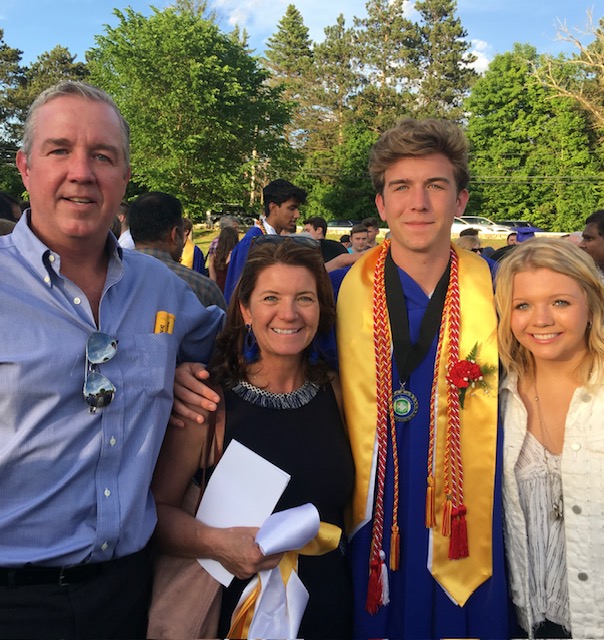
It came one week before her youngest child graduated from high school. While her family was preparing for a major milestone, Alison was undergoing testing and waiting for answers.
For about a month, she and her family kept the diagnosis private until they understood what needed to happen.
“My youngest graduated, and three weeks later I had a double mastectomy,” she says.
In a matter of weeks, Alison found herself moving through the end of one chapter of motherhood and the beginning of breast cancer treatment.
“My kids were all gone, my boobs got chopped off, and I was like, who am I anymore?” she says.
It was not just a medical experience. It was an identity shift — as a mother, as a woman, and as someone trying to understand herself in a changed body and a changed season of life.
What did treatment look like?
Alison’s cancer was stage II and had gone into her lymph nodes, but her Oncotype score was low, so she did not need chemotherapy.
She had a double mastectomy with direct-to-implant reconstruction, followed by six weeks of radiation.
Her cancer was estrogen- and progesterone-positive and HER2-negative. When she did not respond well to Lupron shots for estrogen suppression, she had her ovaries and tubes removed that December.
Then COVID hit.
Alison was grateful that the major parts of her treatment were finished before the pandemic began, but as a nurse, the professional intensity of that time brought a new kind of overwhelm.
“I went from one really intense personal situation to the most intense professional situation I had ever faced,” she says.
How did life move after treatment?
In many ways, Alison never really stopped.
Five weeks after her mastectomy, she left her job and started full-time school nursing, first at Nashoba Brooks and then at Fenn.
Looking back, she recognizes how quickly she moved from one major life change into another.
“I’ve talked to a therapist about this,” she says. “She said a lot of people make these huge life changes during treatment or right after surgery, and I did that.”
Then came COVID, and the demands of nursing during the pandemic.
“I just whisked into something else, and then COVID hit, and then that whisked into something else,” Alison says. “I kind of emerged from all of that like, what the heck has just happened these past few years?”
Why have you kept your story private?
Alison’s close friends and family knew, but for years, she did not talk about it publicly. Even in her work community, only a few people knew her full story.
“I really never have been public about my breast cancer,” she says.
Last summer, Alison had to have her implants removed because of complications. She chose DIEP flap reconstruction because she was not ready to go flat. Taking a month off work meant more people became aware that something was going on, but Alison still did not feel fully comfortable being open about it.
“I feel like I need help processing it all and embracing it all,” she says.
What brought you to Runway?
Alison found her way to Runway through friends who had already experienced the community.
She knew Trisha Ryder and Jen Rick, and after they returned from the Runway retreat this spring, Alison saw something in them that stayed with her.
“They were just so alive and filled with hope and connection,” she says. “They had just had such a positive experience.”
That made Alison wonder whether Runway might offer something she needed.
“Maybe this is what I need,” she says. “Not a new job, not more surgeries, not all these other things. Maybe I need to find a community and connect that way.”
For Alison, stepping onto the Runway stage is not only about sharing her story. It is about letting herself be held by a community that understands the parts of breast cancer that can be difficult to explain.
Why does Runway’s mission matter to you?
Alison is drawn to Runway’s work supporting families facing the cost of breast cancer and loss.
As a nurse, she knows how real and stressful those burdens can be.
“I love supporting families in need,” she says. “I think that’s what it’s all about.”
For Alison, the direct impact of Runway’s work is part of what makes the organization meaningful.
“If you can take that away or help ease that a little bit, I think you see the direct impact,” she says.
How are you feeling about stepping onto the Runway stage?
This will be Alison’s first Runway show.
After years of carrying her story privately, she is stepping onto the stage to be seen, supported, and connected. She walks not only as someone who has completed treatment, but as someone still learning what it means to process the experience and reclaim her story.
On the Runway stage, we look forward to celebrating Alison’s courage, honesty, and willingness to let community become part of her healing.